

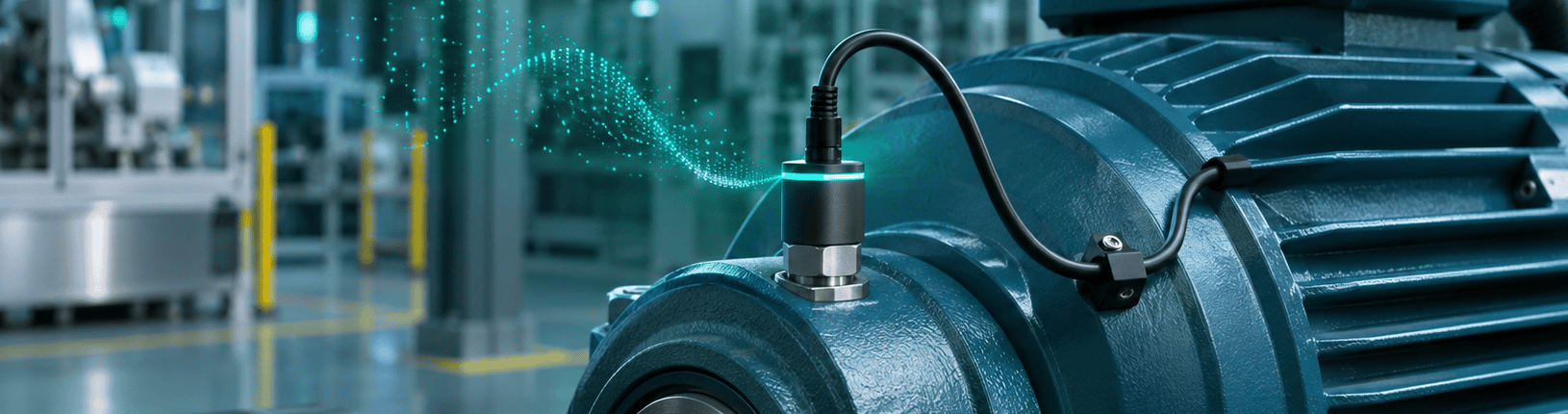
1. MCU Nodes: Why Feature Extraction Matters
Raw vibration, acoustic, or current signals sampled at high frequency are too large and too noisy to store or forward directly. Before anything else, the system needs feature extraction—a way to compress raw telemetry into compact, informative representations.
On Cortex-M devices, TensorFlow Lite Micro can run tiny, quantized models (for example, 1D CNNs - 1-Dimensional Convolutional Neural Network, autoencoders, or DSP+ML hybrids) without dynamic memory allocation. These models learn to extract features that capture the underlying physical behavior of the machine.
Typical flow:
- MCU samples high-frequency sensor data
- TFLite Micro converts it into a small feature vector
- eXtremeDB Edge Client (8KB RAM footprint) logs those vectors transactionally
- Active Replication Fabric™ forwards them reliably to the gateway
This keeps bandwidth low, storage deterministic, and processing local—exactly what embedded engineers need.
2. Edge Gateway: Why Embeddings Matter
Feature vectors alone aren’t enough for anomaly detection. You need a way to compare them—e.g., “Does this vibration pattern look like known bearing wear?”
That’s where embeddings come in.
On the gateway, full TensorFlow or TFLite runs deeper models (e.g. CNNs, LSTMs - Long Short-Term Memory, or temporal transformers) that map incoming feature vectors into a learned similarity space. These embeddings capture the semantic meaning of the machine’s state.
Workflow:
- Gateway receives windowed telemetry
- TensorFlow generates a fixed-length embedding (e.g., 64–256 dimensions)
- eXtremeDB Embedded stores and indexes those vectors using HNSW or Vamana
- ANN search provides fast similarity lookup
Embeddings make it possible to compare current machine behavior against historical patterns in real time. Analyzing the meaning of any divergence between current machine behavior and historical patterns is application-level work.
3. Cloud Training: Building the Embedding Space
Training happens off-device:
- TensorFlow trains Siamese/Triplet models on historical fleet data
- The encoder learns a vector space where “normal” and “fault” states form distinct clusters
- The trained model is quantized and deployed to the gateway
- Reference embeddings (known failure signatures) are stored in eXtremeDB
This creates a shared semantic space across the fleet, enabling consistent anomaly detection (again, application-level work) at the edge.
4. Hybrid Inference Loop: ANN First, Deep Model Second
A practical pattern for embedded deployments:
- Fast ANN Search (eXtremeDB) Quickly identify similar historical states.
- Deep Model Evaluation (TensorFlow) If similarity drops below a threshold, run a secondary model for remaining useful life (RUL) estimation or fault classification.
- Local Mitigation Adjust control parameters, shed load, or trigger maintenance alerts (application-level work) without cloud dependency.
This hybrid approach keeps latency low and reliability high, even in disconnected environments.
Why Embedded Engineers Should Care
- You can run meaningful ML on MCUs without blowing your RAM budget.
- You get deterministic, transactional storage at the sensor.
- You avoid cloud round-trips for anomaly detection.
- You gain fast vector search on the gateway.
- You keep training and heavy lifting in the cloud where it belongs.
Feature extraction makes the data digestible. Embeddings make it comparable. Together, they enable real-time, on-device intelligence across the entire edge pipeline.

Gevorg Melikdjanjan
Security | Reliability | Data Solutions
Building an intelligent edge application?
Want to explore how TensorFlow and eXtremeDB could fit into your embedded application? Let’s discuss your data storage, vector search and edge processing requirements. Schedule a meeting or chat with me.
