

CTE - Classification Tree Editor for Systematic Test Design
Our brands

Design structured and maintainable test cases from functional specifications. CTE helps engineering teams use the Classification Tree Method to define test-relevant aspects, combine input and output values and create clear test case specifications.
Our brands
What CTE does
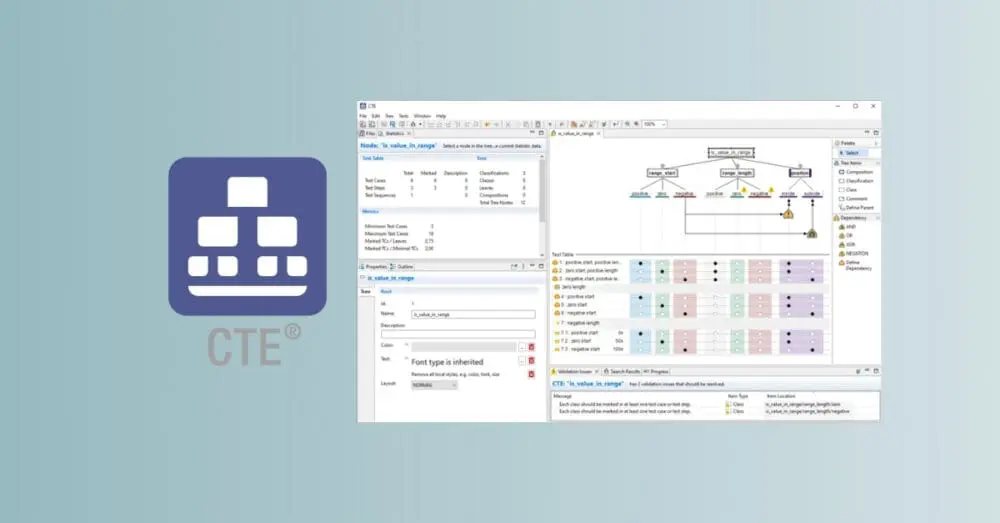
CTE, the Classification Tree Editor, helps engineering teams create structured test case specifications from functional requirements. It uses the Classification Tree Method to identify relevant test aspects, define their values and combine them into clear test cases.
Instead of designing tests in an ad-hoc way, CTE provides a graphical and systematic approach. This helps reduce redundant test cases, improve maintainability and create test specifications that are easier to review, export and reuse.
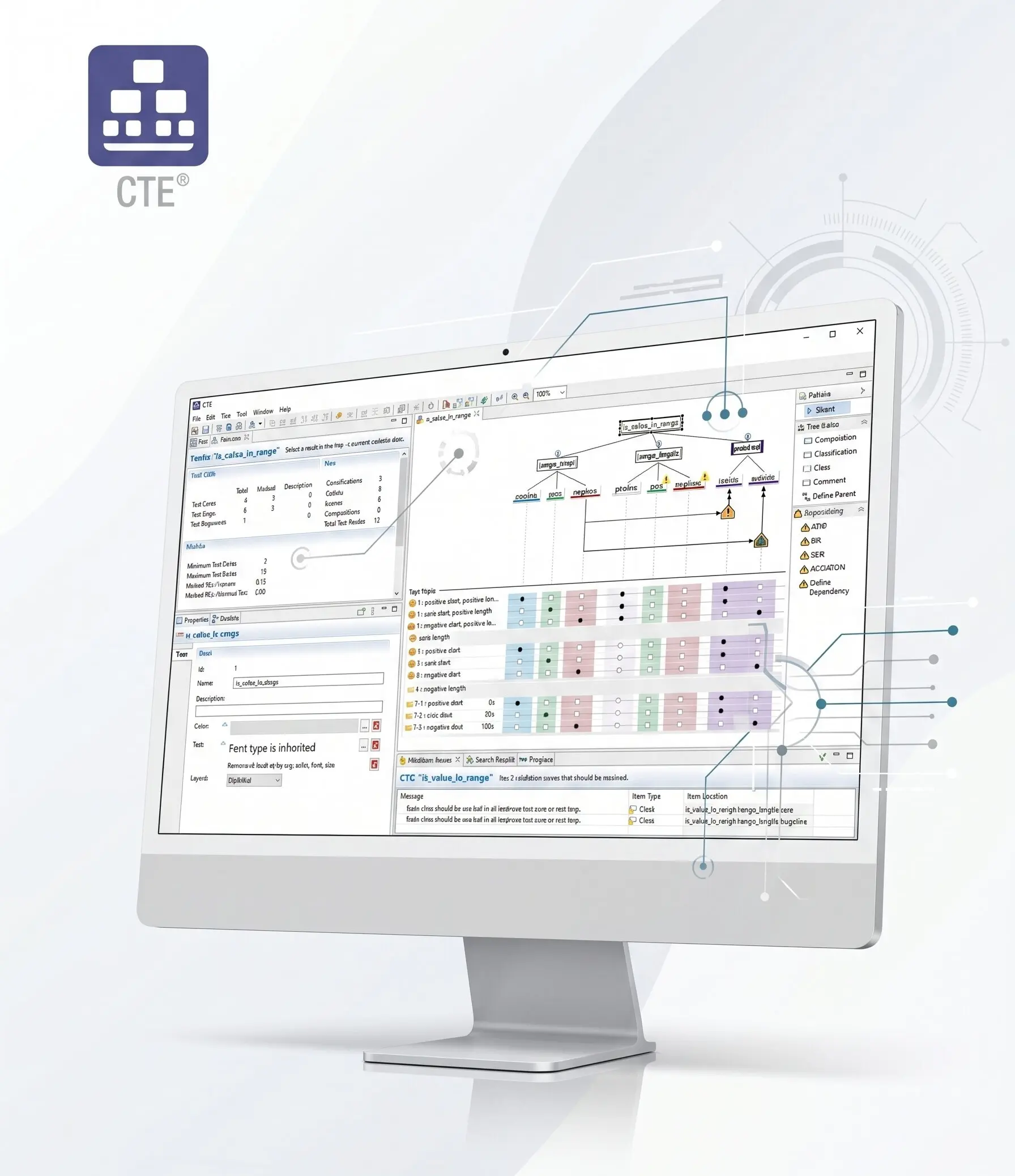
- Graphical test case design using the Classification Tree Method
- Creation of low-redundant and error-sensitive test cases
- Definition of classifications, classes and dependency rules
- Automatic validation checks and statistics
- Export of test specifications to XML, XLSX, TXT, SVG, PNG and JPG
- Available as standalone tool or integrated with TESSY
General Features
Systematic test design
Transform functional specifications into structured test cases using classification trees.
Graphical editor
Build and maintain test case specifications in a clear visual notation.
Low-redundant test cases
Reduce unnecessary test combinations while keeping relevant coverage in focus.
Dependency rules
Define logical relations between test aspects to prevent invalid combinations.
Validation and statistics
Use automatic checks and statistics to improve completeness and consistency.
Export and reuse
Export test specifications for documentation, review or further use in tools such as TESSY.
Why CTE
Test design often becomes difficult to maintain when requirements, inputs and expected results are defined separately. CTE enables a more structured approach:
From ad-hoc test design
to systematic test modelling
to systematic test modelling
From redundant cases
to efficient test coverage
to efficient test coverage
From unclear specifications
to visual test structures
to visual test structures
This results in:
Better test maintainability
across development cycles
across development cycles
More efficient test design
with fewer unnecessary combinations
with fewer unnecessary combinations
Clearer communication
between engineering and test teams
between engineering and test teams
When to use CTE
CTE is most valuable in environments where:
Test cases must be derived from functional specifications
Test design needs to become more systematic
Redundant or invalid test combinations must be reduced
Test specifications need to be reviewed, exported or reused
Typical use cases include embedded software testing, system testing and integration testing where clear and maintainable test design is essential.
Related articles

New Whitepaper: Product Development Before and After AI
Logic Technology partners with Exein to deliver cutting-edge embedded IoT cybersecurity solutions. Secure your devices with real-time threat protection and vulnerability analysis. Learn more about Exein Runtime and Exein Analyzer.
Read more
Press-release: Logic Technology announces new partnership with ARIANNA Team
Read more
Press-release: Logic Technology Now Distributes Razorcat TESSY Across the Benelux
Read more
Embedded World 2026 Recap
Read more
NEW – Percepio Detect 2025.2: Smarter Runtime Anomaly Detection with TaskMonitor and IAR Support
Read more

André De Ceuninck
Software Quality | Testing | Certification
Want to create structured and maintainable test cases?
Get my expert advice on applying CTE for systematic test design and clear test specifications.
